Best Powered Bookshelf Speakers for a Home Desk
A spec-by-spec look at seven powered bookshelf speakers, from a 4.08 lb desktop pair to a 5-year-warranty passive set, with the input layout that actually decides which one belongs beside your monitor.
The best powered bookshelf speakers for video calls are the Edifier R1280T, because two AUX inputs let a laptop and a desk phone stay connected at once, no unplugging. If you edit audio or video for a living, the Edifier MR3 is the better buy with its balanced TRS input and a claimed 52Hz to 40kHz response. What separates this field is not wattage. It's the input panel on the back, and how much desk the cabinet steals.
Best powered bookshelf speakers for video calls at a glance
| Pick | Drivers | Inputs | Price |
|---|---|---|---|
| Best overall Edifier R1280T Powered Bookshelf Speakers |
4 in full range 13mm silk tweeter |
2 x AUX, RCA | Check Price |
| Best premium Edifier MR3 Powered Studio Monitor Speakers |
3.5 in mid-low 1 in tweeter |
TRS, RCA, AUX, BT 5.4 | Check Price |
| Best for heavy use Saiyin Powered Bluetooth Bookshelf Speakers |
3.5 in woofer 0.5 in silk tweeter |
Optical, coaxial, BT 5.3 | Check Price |
| Best compact Electrohome Huntley Powered Bookshelf Speakers |
3 in drivers | RCA, Aux-In, BT 5 | Check Price |
| Best for families MEVOSTO Active Bookshelf Speakers 36W RMS |
5 in bass 1 in silk tweeter |
USB, RCA, AUX, BT 5.4 | Check Price |
| Most versatile Polk Audio T15 Home Theater Bookshelf Speakers |
5.25 in driver 0.75 in tweeter |
Speaker wire only | Check Price |
| Best budget pick NSY Audio Powered Computer Speakers |
3 in | AUX, BT 5.3 | Check Price |
Do the best powered bookshelf speakers for video calls handle your microphone too?
Short answer: no. None of these seven has a microphone, and none of the listings claims one.
That matters because "video calls" is a two-way job and a speaker only does half of it. Your webcam mic or headset handles the talking. These speakers handle the listening, which is the half most people neglect while spending money on a camera.
So judge them the way you'd judge any desk speaker used for speech:
- Driver size. A 3-inch driver in the Electrohome Huntley and the NSY pair sits at the small end here. The MEVOSTO runs a 5-inch bass driver, the Polk T15 a 5.25-inch Dynamic Balance driver.
- Tone control. The R1280T puts bass and treble knobs on the side panel of the active speaker. The MEVOSTO claims 10 levels of each. Pulling bass down is the single most useful thing you can do for voices.
- Input count. A second input means your work laptop and your personal machine both stay plugged in.
- Placement freedom. Speakers either side of a monitor beat a laptop grille firing into the desk, whatever the driver measures.
One more thing to expect: echo. A speaker loud enough to fill a room feeds itself back into an open mic. If you take calls without a headset, keep the volume modest and angle the cabinets slightly outward. That's a physics problem no specification on this page solves.
How I ranked these seven pairs
I set the criteria before I looked at any single listing, then weighted them. Here's the order and the reasoning.
- Input flexibility, weighted heaviest. A desk speaker that forces you to unplug a cable every time you switch machines gets used less. Multiple simultaneous inputs, or a digital input alongside analogue, scored highest.
- Whether it's actually powered. The category name says powered, so a pair needing a separate amplifier drops. Only one here does.
- Published desk footprint. Depth is the figure that decides whether a speaker fits between a monitor arm and the wall, and every listing here publishes dimensions.
- Warranty length, where stated. Five of seven publish one, ranging from 1 year to 5 years. That's a real differentiator when it's on the page.
- Driver and cabinet detail. Silk dome tweeters, MDF cabinets, rear ports. Useful, but the manufacturer's own words.
Why weight it that way? Because inputs and footprint are the two things you cannot fix after the box is open. Tone you can adjust. Wattage claims are unstandardised across brands, so a "60W max" number and a "36W RMS" number are not comparable and I did not treat them as if they were.
Three things got cut in the process. Anything with no published dimensions, because I couldn't tell you if it fits. Anything sold as a single speaker where a pair was implied. And anything whose only stated connection was Bluetooth, since a call machine wants a cable.
1. Edifier R1280T Powered Bookshelf Speakers — Best overall
Two AUX inputs and side-mounted bass and treble knobs make this the easiest pair here to live with on a working desk.
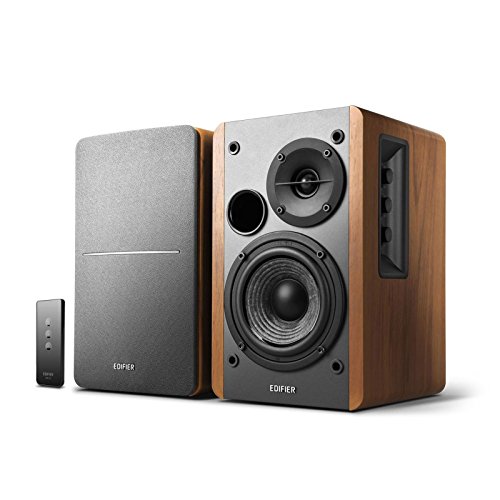
Best for: a desk with two audio sources plugged in at once Skip it if: your desk is shallower than 7 inches
Edifier lists two AUX inputs on the R1280T, and says you can connect two devices at the same time with no plugging and switching. In a set where four of the seven publish a single analogue input, that's the standout. A work laptop stays in one, a personal machine or a monitor's headphone jack in the other.
The driver arrangement is a 13mm silk dome tweeter over a 4-inch full-range unit, which is the largest full-range driver in this set outside the two 5-inch designs. Rated power is 42 watts RMS. Edifier puts bass and treble knobs on the side of the active speaker rather than burying them in an app, so dialling boom out of a conference call takes about three seconds. A remote handles volume.
Physically it's 5.8 x 6.9 x 9.5 in per cabinet, and the listing weight is 10.8 lb. The wood-effect vinyl over MDF reads warmer than the black plastic on most of this list. Warranty is 2 years.
The trade-off is depth and mass. At 6.9 in deep it needs more desk than the Electrohome, and no Bluetooth means every source needs a cable.
Pros:
- Two AUX inputs usable simultaneously
- 4-inch full-range driver plus 13mm silk dome tweeter
- Physical bass and treble knobs on the active speaker
- 2-year stated warranty
- Wood-effect MDF cabinet
Cons:
- No Bluetooth, no optical, no USB
- 6.9 in depth is more than a shallow desk allows
- 10.8 lb listed weight makes shelf mounting awkward
- Only one seller lists it
2. Edifier MR3 Powered Studio Monitor Speakers — Best premium
A balanced TRS input and three switchable sound modes put this in a different job category from the rest of the field.

Best for: editors who need a flat, honest reference Skip it if: you only ever run one 3.5mm cable
The MR3 is the most expensive pick here, and it's also the fastest seller of the seven. Edifier lists balanced TRS alongside RCA and AUX inputs, plus a headphone output and Bluetooth 5.4 with multi-point connection. That's the widest connection list on this page. Multi-point matters for the topic at hand: a phone and a laptop can both hold a wireless connection.
Edifier claims Hi-Res Audio certification with a flat response from 52Hz to 40kHz, and quotes 18W x 2 RMS with a peak SPL of 92.5dB. Drivers are 3.5-inch mid-low units with 1-inch tweeters in an MDF cabinet. Music, Monitor and Custom modes are switchable, which is genuinely useful when the same pair covers speech in the morning and mixing in the afternoon.
Cabinets measure 8.66 x 4.94 x 7.28 in and the listing weight is 9.92 lb. Note the depth: 7.28 in is the second-deepest here. Warranty is 2 years, matching the R1280T rather than beating it.
The catch is spending premium money on monitoring precision you may not use. A flat response is honest, not flattering, and speech through a flat monitor sounds thinner than through the R1280T.
Pros:
- Balanced TRS input, unique in this set
- Bluetooth 5.4 with multi-point connection
- Headphone output built in
- Three switchable sound modes
- Claimed 52Hz to 40kHz response
Cons:
- The highest price position of the seven
- 2-year warranty is beaten by two cheaper picks
- Flat monitoring tuning is unforgiving on voice audio
- 7.28 in depth needs real desk space
3. Saiyin Powered Bluetooth Bookshelf Speakers — Best for heavy use
A 3-year warranty plus optical and coaxial inputs, at an entry price position.

Best for: an all-day machine you want covered for years Skip it if: you need a published weight before you mount anything
The Saiyin pair carries a 3-year manufacturer warranty, the second-longest on this page and the longest of any actively powered pick here. For a speaker that runs eight hours a day, that's worth more than another decibel of output.
Its input panel is unusual for the price. Saiyin lists optical and coaxial digital inputs alongside analogue, plus Bluetooth 5.3. Optical is the input a TV usually offers, so this doubles as a small TV pair without an adaptor. Drivers are a 0.5-inch silk dome tweeter and a 3.5-inch woofer. The listing describes an active-plus-passive arrangement that needs no pre-amp, and notes you can still feed it from a receiver's line out.
Cabinets are 8.5 x 6.5 x 10.6 in overall, with the active unit given as 5.3 W x 6.3 D x 8.6 H in. A remote handles volume and input switching. It's the third-cheapest pick here, which makes the warranty look better still.
Two gaps. The listing publishes no weight, so if you're planning to mount these on a bracket you're guessing. And the 0.5-inch tweeter is the smallest in the set.
Pros:
- 3-year stated warranty
- Optical and coaxial digital inputs
- Bluetooth 5.3 plus analogue
- Remote for volume and input switching
- Third-cheapest of the seven
Cons:
- No published weight anywhere on the listing
- 0.5 in tweeter is the smallest here
- 10.6 in cabinet height is the tallest of the powered picks
- Only one seller lists it
4. Electrohome Huntley Powered Bookshelf Speakers — Best compact
At 4.08 lb and 4.5 in deep, this is the only pair here that fits a genuinely shallow desk.

Best for: shallow desks and monitor-arm setups Skip it if: you want a long warranty
Every dimension on the Huntley is the smallest in this set. Cabinets are 5.9 x 4.8 x 4.5 in and the listed weight is 4.08 lb, less than half the R1280T. If your monitor sits on an arm and the usable desk in front of the wall is five inches, this is the pick that fits.
Electrohome lists RCA, Aux-In and Bluetooth 5, with 3-inch drivers in handcrafted wood cabinets that use a rear port. Rear porting is worth noting on a compact box: it needs a few inches of clearance behind it to work as designed, so pushing these flat against a wall changes what you hear. The listing points at turntables, TVs, computers and consoles as sources, which matches the input set.
It's also the second-cheapest pick here, and the only one in this set with more than one seller listing it.
The compromises are real. The warranty is 1 year, the shortest of the five that publish one. The 3-inch driver ties the NSY pair for smallest, and small drivers in a small cabinet mean bass depth is not what you're buying. It's also the slowest seller of the four picks with popularity data attached.
Pros:
- Smallest footprint here at 4.5 in deep
- Lightest at 4.08 lb
- RCA, Aux-In and Bluetooth 5
- Rear-ported wood cabinet
- Second-cheapest of the seven
Cons:
- 1-year warranty, the shortest published here
- 3 in drivers tie for smallest in the set
- Rear port needs wall clearance to work properly
- No optical, coaxial or USB input
5. MEVOSTO Active Bookshelf Speakers 36W RMS — Best for families
A 5-inch bass driver, USB digital audio and 10-level tone control, in the largest cabinet of the powered picks.

Best for: a shared desk in a living room Skip it if: you need a small footprint
The MEVOSTO pairs a 5-inch bass driver with 1-inch silk dome tweeters and quotes 36W RMS. That 5-inch woofer is the biggest driver among the actively powered picks, which is why this lands as the pick for a shared space rather than a solo desk. Bigger cone, more air, more room filled.
Connectivity is the broadest of the entry-and-mid group: USB digital audio, RCA, AUX and Bluetooth 5.4. MEVOSTO says the USB input takes both a cable to a PC and a flash drive directly. Bass and treble each get 10 adjustment levels, which is more granular than the two-knob approach on the R1280T and lets you build a speech setting and a movie setting.
Cabinets are 9.65 x 6.1 x 5.91 in at 10.1 lb, in brown, with a 2-year warranty.
Here's the honest problem. It sits in the premium price group but its warranty matches the mid-priced R1280T and loses to the cheaper Saiyin's 3 years. It's also the slowest-selling pick of the six with popularity data. You're paying a premium position for driver size and input breadth, not for coverage or track record.
Pros:
- 5-inch bass driver, largest among powered picks
- USB digital audio plus flash drive support
- 10 levels each of bass and treble
- Bluetooth 5.4 and RCA and AUX
- 2-year stated warranty
Cons:
- Premium price position with only a 2-year warranty
- Slowest seller of the picks with data here
- 9.65 in cabinet is bulky for a small desk
- Brown finish is the only colour listed
6. Polk Audio T15 Home Theater Bookshelf Speakers — Most versatile
A 5-year parts and labour warranty and a 5.25-inch driver, but you supply the amplifier.

Best for: anyone who already owns a receiver Skip it if: you have no amplifier and no plans to buy one
Read the connection line first: speaker wire to an AV receiver. The T15 is passive, so it is the one pick here that will not make a sound on its own. That single fact decides whether it belongs on your list.
If you do own a receiver, the case is strong. Polk lists a 5.25-inch Dynamic Balance driver and a 0.75-inch tweeter, and claims clear balanced sound with deep bass even at low volumes. Low-volume clarity is precisely what speech-heavy listening needs. The warranty is 5 years parts and labour, comfortably the longest here. The listing is the only one that ships as a pair in the count field, and the only one that mentions wall mounting. Polk positions it as a starting point you can grow into a 5.1 system with T50 towers and a T30 centre.
Cabinets are 10.7 x 7.3 x 6.5 in at 8.25 lb, and the design dates to 2009, which explains the absence of Bluetooth or any digital input.
The trade-off is the whole point. Adding a receiver means another box, another power cable and more desk or shelf, and that's before considering that a receiver's remote becomes your volume control.
Pros:
- 5-year parts and labour warranty, longest here
- 5.25-inch Dynamic Balance driver, largest in the set
- Wall-mountable and expandable to 5.1
- Sold as a pair
- Polk claims clarity at low volumes
Cons:
- Passive, so a separate amplifier is mandatory
- No Bluetooth, USB, optical or AUX input
- 2009 design with no tone controls of its own
- 10.7 in cabinet height suits a shelf more than a desk
7. NSY Audio Powered Computer Speakers — Best budget pick
The cheapest pick here, with Bluetooth 5.3 and a 6.9 x 5 x 4.8 in cabinet.

Best for: a second desk you barely use Skip it if: you want a stated warranty
The NSY pair is the cheapest of the seven and the least documented. What the listing does give you: a 3-inch driver size, black finish, 6.9 x 5 x 4.8 in cabinets, 6.6 lb, and model NSY-BS01B. NSY claims a max 60W of stereo output, Bluetooth 5.3, and what it calls versatile wired connections with plug-and-play setup and no software install.
Take the 60W figure carefully. Max power and RMS power are different measurements, so it does not compare directly with the MR3's 18W x 2 RMS or the MEVOSTO's 36W RMS. It's a peak number, not a sustained one.
At 4.8 in deep it's the second-shallowest here, only a third of an inch behind the Electrohome, and it lands in the computer speakers category rather than bookshelf speakers, which fits how it's built.
The gaps are the reason it ranks last. No warranty appears on the listing at all, where five of the other six publish one. No popularity data is attached either, so there's nothing to say about how it moves. And the feature list stays generic where the others get specific: no tweeter size, no driver material, no port design. You're buying a shape and a price position.
Pros:
- Cheapest of the seven
- Bluetooth 5.3 plus a wired input
- 4.8 in depth suits a shallow desk
- Plug-and-play with no software
Cons:
- No warranty stated on the listing
- Max wattage claim isn't comparable to RMS figures
- No tweeter, cabinet or port detail published
- 3 in driver ties for smallest here
Which input do you actually need?
This is where most buyers of the best powered bookshelf speakers for video calls get it wrong. They compare wattage, then discover the back panel doesn't match their machine.
Work backwards from what's on your desk:
- One laptop, headphone jack only. Any pick here except the Polk T15 works. Pick on footprint and warranty instead.
- Two machines you switch between. The R1280T's two simultaneous AUX inputs, or the MR3's Bluetooth multi-point, solve this. Nothing else here does.
- A desktop tower with no good analogue output. The MEVOSTO's USB digital audio input is the clean route. USB carries the signal and skips the PC's analogue stage.
- A TV sharing the same speakers. Saiyin's optical and coaxial inputs are the only digital TV-friendly connections in this set.
- An existing AV receiver. The Polk T15 becomes the value pick, because you already own the expensive half.
One habit worth building regardless of pick: keep a short 3.5mm cable permanently plugged into a spare input. Wireless connections drop at the worst moment, and a cable you can grab in two seconds saves a meeting.
How much desk does each pair eat?
Depth is the figure that decides fit, and it's the one nobody checks. Measure from your monitor stand to the wall before you buy anything.
Sorted shallowest to deepest, by the depth figure in each listing:
- Electrohome Huntley, 4.5 in
- NSY Audio, 4.8 in
- Edifier MR3, 4.94 in
- MEVOSTO, 5.91 in
- Polk T15, 6.5 in
- Edifier R1280T, 6.9 in
- Saiyin, 6.5 in on the pair, 6.3 in on the active unit
Weight tells a second story. The Huntley's 4.08 lb means a cheap bracket holds it. The R1280T at 10.8 lb and the MEVOSTO at 10.1 lb want a solid shelf. The Saiyin publishes no weight at all, which rules it out of any mounting plan until you have the box in hand.
Two placement notes that matter more than an inch of depth. Rear-ported cabinets, which the Electrohome and Saiyin both describe, need clearance behind them. And tweeter height should land near ear level, so a pair sitting flat on a low desk will sound duller than the same pair on small stands. Cheap foam risers fix that for less than the cost of upgrading a driver.
What more money buys in this set
Three tiers show up clearly, and what they buy is not simply louder.
Entry. The NSY, Electrohome and Saiyin picks. Here you get a working speaker and a small cabinet. The surprise is that the Saiyin, at the top of this tier, carries a 3-year warranty and two digital inputs, which is better coverage and better connectivity than either premium Edifier. The NSY at the bottom of the tier publishes no warranty at all. So within the cheapest group, the spread in what you actually get is wider than the spread between tiers.
Mid. Just the R1280T. What the step up buys is the input flexibility nothing else here matches, plus physical tone controls and a 4-inch full-range driver. That's why it wins overall: the single most useful upgrade in this category is a second input you can leave connected.
Premium. The MR3, the MEVOSTO and the Polk T15. Money here buys specialisation rather than general improvement. The MR3 buys balanced TRS and a flat 52Hz to 40kHz claim, useful only if you're editing. The MEVOSTO buys a 5-inch driver and USB audio. The Polk buys a 5.25-inch driver and 5 years of parts and labour, but costs you an amplifier you have to supply.
The pattern: paying more here does not reliably buy a longer warranty or a better input panel. It buys a bigger driver or a specialist connection. Decide which of those you need before you climb tiers.
The verdict
The Edifier R1280T is the winner because of one thing the rest of this field mostly lacks: two AUX inputs you can use at the same time. On a desk where a work laptop and a personal machine both want audio, that removes the daily cable swap that makes people give up on desk speakers entirely. Add a 4-inch full-range driver, a 13mm silk dome tweeter, side-panel bass and treble knobs and a 2-year warranty, and it's the pair that handles speech and music without asking anything of you.
Two conditions flip it. First, if your desk depth is under 6 inches, the R1280T at 6.9 in deep simply won't sit right, and the Electrohome Huntley at 4.5 in and 4.08 lb becomes the pick. Second, if you edit audio or video professionally, the Edifier MR3's balanced TRS input and claimed flat 52Hz to 40kHz response give you a reference the R1280T's tuned-for-pleasure voicing cannot.
The MR3's exact advantage is honest connectivity: TRS, RCA, AUX, a headphone output and Bluetooth 5.4 multi-point, on one back panel. Nothing else here comes close. It just costs the most and its 2-year warranty is beaten by the cheaper Saiyin's 3 years.
FAQ
Are powered bookshelf speakers worth it over a laptop's built-in audio?
Powered bookshelf speakers are worth it if you spend hours listening to speech. A laptop grille fires downward into a desk, which smears consonants. Separating left and right by a couple of feet at ear height makes voices easier to follow, and the tone controls on picks like the R1280T let you cut the bass that muddies speech. The upgrade is clarity, not volume.
Do the best powered bookshelf speakers for video calls include a microphone?
The best powered bookshelf speakers for video calls do not include a microphone, and none of the seven pairs here claims one. Your webcam, headset or a separate USB mic handles the input side. Expect to manage echo too: an open mic near a loud speaker feeds back. Keep volume moderate, or use a headset when you speak and the speakers when you listen.
What's the difference between the Edifier R1280T and the Edifier MR3?
The difference between the R1280T and the MR3 is purpose. The R1280T offers two simultaneous AUX inputs, a 4-inch full-range driver and side knobs, tuned for enjoyable everyday listening. The MR3 adds balanced TRS, a headphone output, Bluetooth 5.4 multi-point and a claimed flat 52Hz to 40kHz response, aimed at monitoring. The MR3 costs more; the R1280T is the friendlier desk speaker.
Will passive speakers like the Polk T15 work without an amplifier?
Passive speakers like the Polk T15 will not work without an amplifier. The listing specifies speaker wire connected to an AV receiver, so the T15 has no built-in power stage. Budget for a receiver or integrated amp on top. In exchange you get a 5.25-inch Dynamic Balance driver, a 5-year parts and labour warranty and a path to a 5.1 setup.
How much desk depth do bookshelf speakers need?
Desk depth needs range widely across this set: 4.5 in for the Electrohome Huntley up to 6.9 in for the Edifier R1280T. Measure from your monitor base to the wall first. Rear-ported cabinets, including the Electrohome and Saiyin, need extra clearance behind them or the bass response changes. Foam risers that lift tweeters toward ear level help more than an extra inch of cabinet.
Start with the measurement, not the model name. Pull a tape across the gap between your monitor and the wall, then check it against the depth figures above, and half this list will eliminate itself in ten seconds. From what survives, count your sources: one machine means take the cheapest pick that fits, two means the Edifier R1280T and its pair of live AUX inputs. That second input is the reason the R1280T stays the default here. It's the feature you stop noticing, because you never have to reach behind the speaker again.
Last updated: September 7, 2026. Product availability re-checked.
This page contains affiliate links. As an Amazon Associate we earn from qualifying purchases, at no extra cost to you.